
Table of Contents
Introduction
Choosing between martial arts training and a dedicated self-defence program can be confusing, especially if your main goal is to feel more prepared in unfamiliar or uncomfortable situations. While both can teach practical skills, their training methods, structure and objectives may differ. Self-Defence Training in Edmonton can take different forms, from focused scenario-based instruction to martial arts programs that incorporate defensive skills into regular training.
Understanding those differences can help you decide what fits your goals, whether you are looking for fitness, confidence, discipline, practical awareness or a structured martial arts journey.
What Is the Difference Between Taekwondo and Self-Defence?
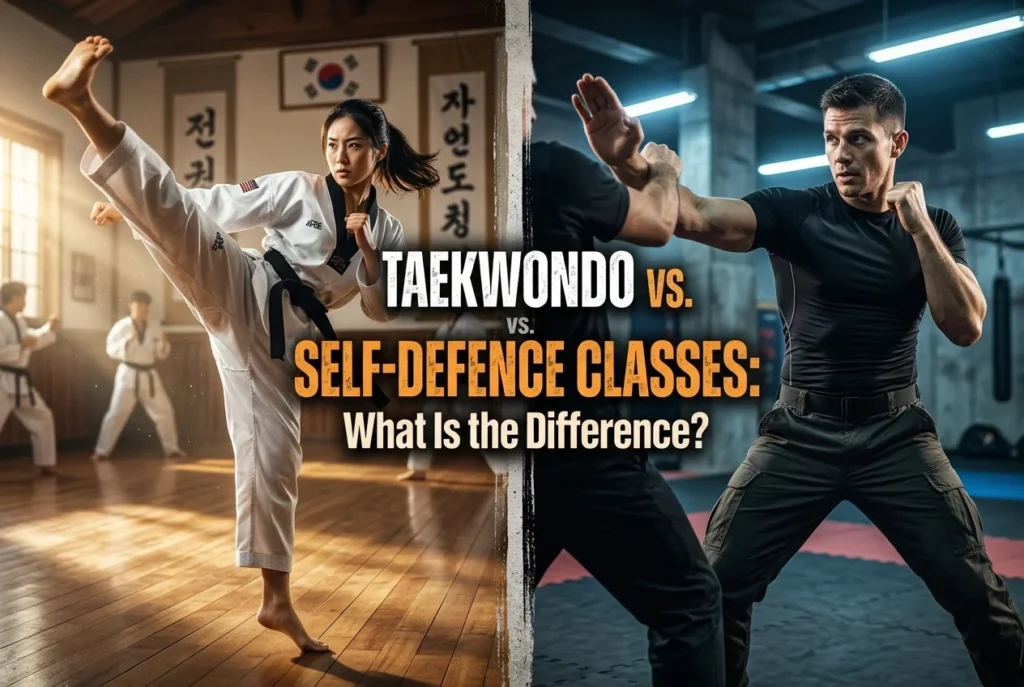
The difference between Taekwondo and self-defence largely comes down to the purpose and structure of training.
Taekwondo is a structured Korean martial art that develops kicking, striking, blocking, movement, balance, flexibility, discipline and controlled sparring. Depending on the school, training may also include patterns, belt progression, breaking and self-defence applications.
Self-defence classes focus more directly on responding to potential real-world situations. Training may cover awareness, boundaries, escape strategies, defensive movements and scenario-based drills, often without requiring prior martial arts experience.
Neither approach excludes the other. Taekwondo can incorporate self-defence skills, while dedicated self-defence training can complement martial arts practice.
I have never trained before. Will I feel comfortable starting a martial arts program?
Absolutely. Our instructors introduce fundamental movements gradually, allowing beginners to build coordination, confidence and familiarity with training before progressing toward more challenging skills.
How Taekwondo Training Differs From Self-Defence Classes
Structured Skill Development
One defining feature of Taekwondo is its progressive structure. Students learn fundamental movements before advancing to more complex techniques and combinations. Progress can be measured through a curriculum and, depending on the school, a belt or promotion system.
Dedicated self-defence classes are often organized around specific situations rather than a long-term martial arts curriculum. They focus on learning practical responses and repeating them until they become familiar.
Sport, Discipline and Practical Skills
Taekwondo combines physical training with discipline, concentration, confidence and technical development. Sparring helps students practise timing, distance, footwork, and reactions in a controlled setting.
Self-defence training focuses more directly on personal safety and decision-making. Students may spend more time learning awareness, avoidance, boundaries and ways to move away from potentially dangerous situations.
Will I need to be physically fit before joining classes?
No. Our classes can help you develop fitness progressively through movement, drills and conditioning. You can begin at your current ability level and build strength and coordination gradually.
What Skills Can You Learn in Self-Defence Training?
Practical self-defence techniques can vary considerably between programs. A well-rounded class may cover more than physical responses to an attack.
Depending on the curriculum, students may work on:
- Recognizing unsafe situations
- Maintaining distance and boundaries
- Verbal de-escalation and assertive communication
- Basic escapes from grabs
- Safe movement and positioning
- Falling and recovering safely
- Basic striking and blocking
- Creating opportunities to disengage and seek help
The objective is not necessarily to teach students to fight. In many self-defence programs, awareness, avoidance and escape are important parts of the training.
Does self-defence training teach me how to avoid dangerous situations?
Yes. Our approach can include awareness, positioning, boundaries and practical responses that focus on recognizing risks, creating space and safely disengaging from potentially unsafe situations.
What Skills Does Taekwondo Develop?
Taekwondo provides a broader physical and technical training experience. Students typically practise movement patterns, kicks, strikes, blocks and combinations while developing coordination and body control.
Regular training can also involve:
Balance and Footwork
Movement is central to effective martial arts practice. Students learn to control their stance, shift their weight and move with greater coordination.
Speed and Reaction
Repeated drills help students become familiar with movements and respond to training partners in controlled situations.
Flexibility and Physical Conditioning
Kicking and movement exercises require mobility, coordination and muscular control. Regular classes can therefore provide a physically active workout.
Discipline and Confidence
Following a structured curriculum gives students clear skills to practise and goals to work toward. This can be particularly useful for children and teenagers who benefit from consistent routines.
These elements are also reflected in Edmonton martial arts programs, where Taekwondo may be offered for different age groups, including children, juniors, adults and families.
Can martial arts training help my child become more disciplined?
Structured classes provide regular practice, clear expectations and progressive goals, helping children develop concentration, consistency, coordination and confidence alongside their physical skills.
Which Training Is Suitable for Beginners?
If you have never trained before, both beginner martial arts classes and introductory self-defence programs can provide a good starting point.
Those seeking practical responses to common situations may prefer a short, focused self-defence course. Those wanting progressive skill development through regular training may prefer a martial arts program.
Taekwondo classes in Edmonton can provide a structured pathway for long-term training, with programs for different ages and experience levels.
The right choice depends on your training goals, not which style sounds more practical.
My child has never taken martial arts classes before. Can they start with other beginners?
Yes. Beginner martial arts classes offer an accessible starting point, with fundamental movements taught progressively so new students can feel comfortable before moving on to more complex techniques.
How to Choose Between the Two
Before joining a Taekwondo school or self-defence program, consider what you want to achieve.
Choose Based on Your Goals
- Learn practical responses quickly: Self-defence-focused classes
- Develop martial arts skills over time: Taekwondo
- Improve kicking, movement and coordination: Taekwondo
- Learn awareness and escape strategies: Self-defence training
- Build a structured fitness routine: Taekwondo or martial arts classes
- Develop discipline through progressive training: Taekwondo
- Learn skills around specific scenarios: Self-defence classes
The two approaches can overlap. Many martial arts programs include self-defence, while dedicated self-defence classes may use techniques adapted from martial arts.
Should I choose classes based on fitness or self-defence goals?
Consider your primary objective, preferred training style and commitment level. Our team can explain the program structure so you can decide which approach best fits your goals.
Finding Martial Arts Training in Edmonton
For Edmonton residents, the choice can depend on age, experience, schedule and personal goals. Those in Mill Woods, Summerside, Clareview, West Edmonton and nearby communities can look for a program with a suitable training environment and curriculum.
At Hong Park Tae Kwon Do College, students can explore a structured martial arts program while developing physical skills, discipline and awareness. If your primary interest is Self-Defence Training in Edmonton, ask how self-defence is incorporated and whether the training matches your expectations.
Rather than focusing only on the class name, consider what you will practise, how beginners are taught and whether the environment suits your age and goals.
What should I ask before enrolling my family in a Taekwondo school?
Ask about class structure, age groups, beginner instruction, training expectations and how defensive skills are incorporated. This helps you understand whether the program suits your family.
Choose the Training That Fits Your Goals
The main difference between Taekwondo and self-defence is the scope and purpose of training. Self-defence classes generally focus on awareness, practical responses, and escaping potentially unsafe situations, while Taekwondo offers a broader, structured martial arts curriculum involving movement, kicking, striking, conditioning, discipline, and progressive skill development.
If you are exploring Self-Defence Training in Edmonton, consider whether you want focused defensive instruction or a longer-term martial arts program that can incorporate self-defence skills. Contact Hong Park Tae Kwon Do College to learn more about its training options and find an approach that aligns with your goals.
Frequently Asked Questions
1: How long does it usually take to become comfortable with basic Taekwondo movements?
Progress varies by student, but regular attendance and consistent practice can help you become familiar with basic stances, movements, kicks and combinations over time.
2: Can adults join Taekwondo classes if they have no previous martial arts experience?
Yes. Adults can begin with fundamental movements and gradually develop coordination, flexibility, balance and confidence without needing previous martial arts experience.
3: Are self-defence techniques useful outside a classroom?
Training can improve awareness, positioning and responses through controlled practice. However, no technique guarantees safety, and avoiding confrontation and seeking help remain important priorities.
4: Does Taekwondo involve physical contact during training?
Some classes may include controlled partner drills or sparring, depending on the program. Training should follow appropriate safety practices and gradually introduce contact as students develop skills.
5: Can I practise martial arts while improving my overall fitness?
Yes. Regular martial arts training can involve cardiovascular activity, mobility work, balance exercises, coordination drills and strength-building movements as part of structured classes.
6: What should I wear to my first martial arts class?
Comfortable athletic clothing that allows unrestricted movement is generally suitable for an introductory session. Your instructor can explain any specific uniform or equipment requirements for regular classes.
7: Is self-defence training only useful for people who expect dangerous situations?
No. Training can build situational awareness, confidence, communication, and decision-making skills that help you recognize risks and respond appropriately in uncomfortable situations.
8: How is sparring different from practising self-defence techniques?
Sparring involves controlled interaction between training partners, while self-defence drills often focus on specific situations, responses and disengagement. The two develop different but complementary skills.
9: Can martial arts training help improve coordination?
Yes. Repeated kicking, blocking, stepping and combination drills require the body to coordinate movement, balance and timing, which can gradually improve overall movement control.
10: Do children and adults follow the same martial arts curriculum?
Not necessarily. Instruction can be adapted to age, physical development and experience, allowing children and adults to learn fundamental skills in an appropriate training environment.